Jelly Sandal Buckles Adjust Less Than You Think
A week in a clear two-buckle PVC sandal showed why tighter holes do not always stop sliding. Soft straps stretch under load, while the buckle can introduce its own sore spot.
October 4, 2026 · 7 min read
The buckle looked more useful than it was
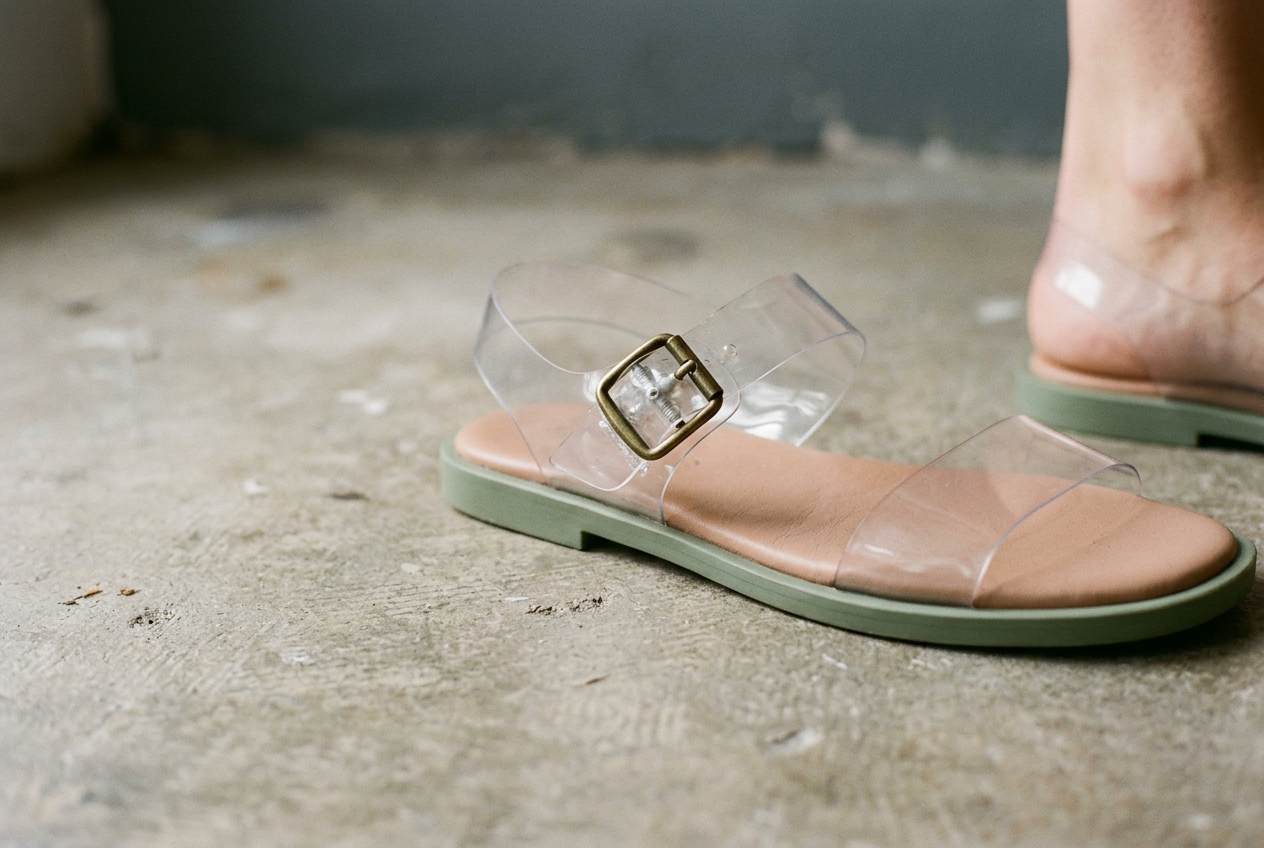
The test pair was a clear, two-buckle jelly sandal molded from soft PVC, or polyvinyl chloride, with a flat footbed and separate straps over the forefoot and instep. I wore it in my usual size for one week, mostly on dry pavement, indoor floors and stairs, with one short damp-foot test to reproduce the familiar summer condition of being near water without doing anything glamorous in it.
This is unisex fit advice. The mechanics apply across wardrobes, although shoppers buying from a gendered size chart should convert by foot length rather than assuming the same number means the same internal space.
On the first fitting, the buckles created a persuasive little ceremony. The forefoot strap could be moved inward by one hole, while the upper strap could be tightened until it sat neatly against the instep. Visually, the sandal appeared more fitted than a fixed-band jelly slide. That appearance lasted while standing still.
Walking changed the equation. As the foot rolled forward, the PVC lengthened slightly between the buckle and the inside edge of the foot, then relaxed when the weight moved away. The buckle stayed exactly where it had been fastened, but the usable loop around the foot became temporarily larger. A metal buckle can hold its position perfectly while the material attached to it behaves like a less committed employee.
By the end of the week, the same holes still closed, yet they no longer described security in a useful way. The upper strap controlled some vertical movement at the instep. It did much less for the forward slide that pushed the toes toward the front edge.
Why one tighter hole may change very little
Conventional buckle spacing assumes the strap between the hardware and the foot remains reasonably stable. Leather can soften and webbing can loosen, but soft molded PVC flexes along the whole loaded section, especially once warmed by skin and pavement. The distance between holes measures the strap at rest. It does not measure how far the strap gives during a step.
That distinction matters because a foot does not pull evenly against a sandal. At push-off, when the heel rises and the toes help propel the body forward, the forefoot presses against the upper while the sole tries to continue underneath it. This creates shear, meaning force that moves two surfaces sideways against each other. In the clear test pair, the strap yielded enough for the foot to shift before the buckle setting became relevant.
Moving the forefoot buckle one hole tighter reduced the visible gap while standing. During walking, it also pressed the strap edge more firmly into the outer side of the foot, where the PVC bent around the buckle frame. Forward travel improved only modestly because the flexible span still stretched. The adjustment traded some sliding for more concentrated pressure.
The instep buckle earned its keep more convincingly. Fastened snugly, it reduced heel lift, the gap created when the heel rises away from the footbed, and made the sandal quieter on stairs. Tightened beyond that point, it stopped being helpful and began marking the skin. PVC does not distribute pressure as gracefully as a padded textile or a broad leather strap.
It tends to announce the edge.
The useful setting was therefore not the tightest hole I could close. It was the loosest hole that prevented the upper from floating above the instep during an ordinary step. That is a smaller promise than a locked-in fit, but it is one the sandal could keep.
The new rubbing point sits beside the hardware
A fixed-band jelly slide commonly rubs along a broad upper edge or allows the foot to skate forward. Adding buckles can move the problem rather than remove it. On the test pair, the first persistent irritation appeared beside the forefoot buckle, where the strap turned sharply through the frame and became less flexible.
The buckle itself did not touch bare skin. The reinforced bend around it did. Each time the forefoot widened under body weight, that firmer section pressed into the outside edge of the foot, while the softer span closer to the toes stretched away. After a week, the clear PVC showed a crease and a slightly polished patch at that bend, both useful evidence that the same small area had been taking repeated load.
Loosening the buckle removed the concentrated pressure but restored more sliding. Tightening it again did not improve control enough to justify the rub. This was the central tradeoff of the pair: the hardware offered adjustment on paper, while the material decided how much of that adjustment reached the foot.
Moisture made the compromise less charming. A damp foot slid more easily over the smooth footbed, so the toes moved forward until the straps caught them. The buckles could limit upward movement, but they could not add friction beneath the sole. Anyone expecting these sandals to behave like secure water shoes will receive a brief lesson from physics, probably near a tiled floor.
Test the strap, not just the holes
A useful try-on takes longer than fastening both buckles and looking down. Start with the sandal at room temperature and set each strap so one fingertip can pass beneath it without forcing. Walk far enough for the forefoot to flex repeatedly, then climb a few steps if the store setup allows it. Watch the foot, not the hardware.
The forefoot should not travel far enough for the toes to grip or approach the front rim. The heel should rise only slightly, without the instep strap snapping back against the skin. If tightening one hole creates a sharp pressure point but leaves the forward slide largely unchanged, the problem is the sandal’s geometry or material, not a shortage of buckle options.
Press and pull the strap between the buckle and the foot. A very soft span that lengthens easily will behave differently from a denser molded upper, even when both sandals offer the same number of holes. Check the underside around the buckle attachment as well. A bulky return, where the strap folds back after passing through the hardware, can become the rubbing point once the foot swells in warm weather.
Footbed shape deserves equal attention. The test pair was flat and smooth, with little contour to resist forward movement. A shallow heel cup, meaning a raised area that cradles the heel, or a lightly textured surface can control sliding before the strap has to intervene. Neither feature turns jelly into a technical walking sandal, but both ask less of the buckle.
Do the test again after the material warms against the foot. If a pair feels secure only while cool, its store fit may be flattering evidence. Soft plastic usually becomes more pliable with heat, which is precisely when summer footwear gets asked to work.
Where the money makes sense
Buckled jelly sandals usually sit in the budget to midpriced fashion-sandal band, though decorative hardware and branding can push them higher. Paying more may improve the buckle finish, sole thickness or molding quality. It does not repeal material behavior. A costly soft strap can still stretch.
The clear test pair made sense as an occasional style shoe for short errands, poolside use where careful steps are realistic, or an outfit that needs the visual structure of buckles without the formality of leather. It did not earn a role as an all-day walking sandal. After the first rubbing point appeared, continued wear would have meant accepting discomfort for research, which is how footwear writing becomes an administrative error.
For easy on-and-off wear, a fixed wide-band jelly slide was the cleaner alternative. It offered less pretense of adjustability, but its broad upper spread pressure across more skin. For genuine security, a sandal with firmer straps and a contoured footbed worked better because the upper resisted stretching while the sole helped locate the foot. The buckled jelly occupied the middle: more visually finished than the slide, less mechanically convincing than the firmer sandal.
Keep it if the warm-material walking test shows little forward movement and no hard bend beside the buckle. Skip it when each tighter hole merely relocates the discomfort. The useful number is not the hole count. It is how far the foot moves before the strap begins doing its job.
Questions people ask
Do buckles stop jelly sandals from sliding?
They can reduce heel lift and keep the upper closer to the foot, especially when the instep strap is positioned well. They cannot fully stop forward sliding if the PVC stretches under load or the footbed is smooth and flat. Strap firmness and sole shape matter more than the mere presence of hardware.
Should jelly sandals feel tight when new?
They should feel close, not pinched. A strap that already leaves a sharp edge mark while the material is cool is unlikely to become more pleasant after heat makes the foot swell. Walk until the plastic warms, then reject any pair that needs painful tension to keep the toes back.
Are buckled jelly sandals good for wide feet?
Adjustable straps can accommodate width, but only if the buckle bend and strap edges stay clear of the widest part of the foot. Soft PVC may stretch over a broad forefoot while the reinforced section beside the hardware remains rigid, creating pressure in one concentrated spot. Try them warm and under full body weight.
What is a more secure alternative to a jelly sandal?
Look for a sandal with firmer straps, a textured or contoured footbed and a shallow heel cup. If the jelly look matters more than walking support, a wide fixed-band slide can be the more honest choice: it may still slip, but it removes the buckle bend that caused rubbing on the test pair.
One update a day
Today's fashion update, in your inbox
One fashion update each morning — no hype, no filler, just pieces worth wearing.