Your Slingback Strap Slips Because the Shape Is Wrong
Sizing down may crowd your toes without securing the strap. Check its angle, heel curve, elastic and buckle range before blaming the number on the box.
Women's · October 2, 2026 · 8 min read
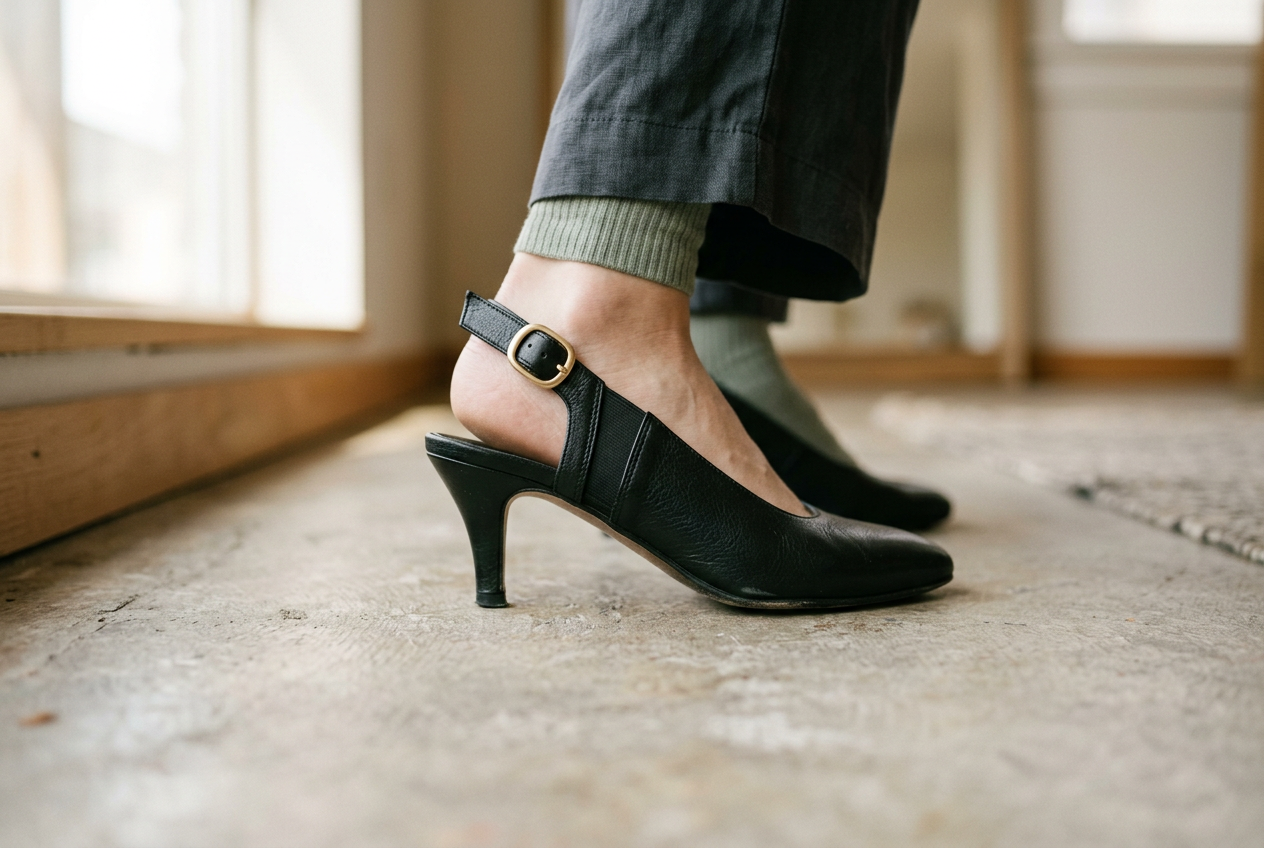
The test case is a pointed black leather slingback pump with a leather lining, a mid-height covered heel and a narrow strap that buckles at the outer side. A short elastic insert sits near the inner quarter, meaning the side section of the shoe, where it can stretch as the foot moves.
This is women’s footwear coverage, though the fitting mechanics apply to any slingback built the same way. I wore the pump through a week of indoor fittings and short errands, adjusting the buckle and comparing its original size with the smaller size usually offered as the obvious cure. The smaller shoe held the heel a little more firmly. It also compressed the toes while the strap continued to drop during longer steps.
Excellent. Two problems for the price of one.
The original size had enough toe length, and the widest part of the foot aligned with the widest part of the shoe. Those are useful signs that the base size was right. The failure was behind the foot: the strap approached my heel too horizontally, met a sharply curved area and shifted downward whenever the shoe flexed.
Why a smaller shoe does not fix the strap
A slingback has no full heel counter, the shaped rear structure that normally contains the heel in a pump. The strap has to do that work while allowing the ankle to flex, which makes its route around the foot more important than a small change in overall shoe length.
Sizing down pulls the back of the shoe slightly closer, but it also moves the toe box, ball position and arch placement. If the original shoe already bends where your foot bends, shortening it can put the shoe’s flex point behind the ball of your foot while forcing the toes into the taper. The strap may feel tighter in the fitting room because the whole foot is wedged forward. Once you walk and the upper warms, the underlying angle remains.
On the black pump, sizing down reduced empty space at the heel but did not change where the strap met it. The strap still traveled over the rounded lower part of the heel instead of settling into the narrower area above it. Each step pushed it lower. Toe crowding supplied distraction, not a repair.
Size down only when the whole shoe is too long: the ball of the foot sits behind the shoe’s widest point, the arch feels misplaced, or the foot slides forward despite a secure forefoot fit. A loose rear strap on an otherwise well-positioned shoe points elsewhere.
Read the strap angle from the side
Put both shoes on and stand naturally, without pointing your toes or clenching them to keep the shoes aboard. Viewed from the side, the strap should rise from its attachment point and meet the back of the heel without being forced into a sharp bend. Its top and bottom edges should lie flat rather than twisting.
A strap set too low can land on the fuller, more rounded part of the heel, where walking motion encourages it to slide down. One set very high may cut into the Achilles area, particularly if its edge is stiff or narrowly folded. Neither becomes well behaved through determination.
The useful fitting check takes less than a minute. Walk at your normal pace, make a tight turn, then take several longer steps. A workable strap stays in roughly the same place as the heel rises and settles; a poor one creeps lower with every stride, even after the buckle has been tightened enough to leave an obvious mark.
That final detail matters. Tightness and position are different. A badly angled strap can be painfully tight and still slip because pressure does not alter the direction in which the material wants to travel.
Match the shoe’s curve to your heel
Heels vary in profile. Some run fairly straight below the ankle, while others have a more pronounced curve above the base of the heel. A slingback shaped over a last, the foot-shaped form used to build a shoe, carries a particular version of that curve whether or not it resembles yours.
Look down at the shoe while standing. Your heel should sit centrally over the sole rather than spilling toward one side, and the strap should wrap around it with even contact. A gap at the center back while the strap presses at both sides suggests that the curve is too shallow. Pressure in the center with loose edges suggests the opposite.
The black pump showed contact at the sides but a small central gap. Tightening the buckle drew those side points inward first, so the strap pinched without gaining much grip across the back. That is a shape mismatch. A different slingback with a more curved strap line is a better purchase than the same pump half a size smaller.
Heel shape also explains why reviews split so dramatically on slingbacks. Two people can have feet of similar length and width yet get different results from the same strap. The shoe is not changing its mind. It is meeting different geometry.
Elastic can stabilize or undermine the fit
The elastic insert allows the strap to lengthen as the ankle moves, which can prevent cutting and make the buckle easier to use. Its placement determines how much control remains.
A short insert near the side generally preserves a continuous section across the heel. If the elastic is long, very soft or positioned where the strap needs to grip, the rear section can expand each time the foot lifts and then settle lower. Smooth elastic against smooth hosiery is particularly mobile.
Check it while the shoe is off. Hold the strap near its attachment points and pull gently. The elastic should extend enough to accommodate movement, then recover without leaving the strap visibly longer. On a shop floor, compare both shoes; elastic can be distorted by repeated try-ons, and one loose side is enough to produce an irritatingly uneven walk.
Material changes the calculation. Suede-backed straps tend to grip more than slick synthetic linings, while smooth leather may gain some flexibility with wear. Patent-coated leather usually gives less readily. None of this guarantees comfort, especially when a narrow edge sits against bare skin, but it tells you whether break-in is likely to soften pressure or merely create more slack.
Use the buckle as a diagnostic tool
Start near the middle of the buckle range rather than immediately choosing the tightest hole. This leaves room for minor adjustment as the upper settles and reveals whether the strap was cut to suit your heel at all.
With the black pump, the middle hole was loose and the next hole produced better contact, but the tightest setting pulled the buckle toward the ankle without correcting the central gap. That pattern says the available range is not the main problem. More holes would shorten the strap, not reshape it.
A cobbler can add a clean hole when the correct tension falls between existing settings, provided there is enough strap beyond the buckle and the new position will not drag hardware against the foot. That is a modest alteration. Rebuilding the strap angle or moving its attachment points is more involved and rarely makes sense on an ordinary purchase that can still be returned.
Avoid punching a rough hole before deciding to keep the shoes. It can split a thin synthetic strap, weaken edge paint and end the return conversation rather efficiently.
Try low-cost adjustments without stealing toe space
If the strap geometry is close rather than fundamentally wrong, a thin self-adhesive suede strip placed inside the rear section can add friction and reduce a small amount of excess volume. Test it temporarily because adhesive may mark leather or lift a delicate lining.
A slim forefoot pad can help when the foot slides forward and leaves the heel too far from the strap. Choose the thinnest version that stops movement without raising the toes into the upper. The aim is to hold the foot where the shoe was designed to carry it, not to pack every cavity until circulation becomes theoretical.
Conventional heel grips are less convincing here. They are designed to sit inside a closed heel counter, while a slingback offers no broad rear wall to support them. Bulky pads stuck directly to a narrow strap often create a ridge, collect lint and shift the pressure onto a smaller patch of skin.
For the black pump, the forefoot pad improved positioning but could not correct the shallow rear curve. It turned an immediate slip into a later slip, which is useful information but not a reason to keep an unsuitable shoe.
A better fitting-room decision
Try slingbacks on both feet with the hosiery, if any, that you expect to wear. Feet often differ slightly, and a strap that behaves on the smaller foot may expose the limits of its buckle range on the larger one.
Check toe space and ball alignment first. Then inspect the strap from the side, walk far enough for the sole to flex and notice whether the buckle is still sitting where it began. A few careful steps on a clean floor cost less time than an afternoon spent curling your toes to retain custody of a shoe.
Do not let price overrule the result. Expensive slingbacks can use finer leather, cleaner edge finishing and better hardware while still being built on a curve that misses your heel. Lower-priced pairs can fit well if the angle happens to agree. Construction quality affects durability; geometry decides whether the strap stays up.
Questions people ask
Should
I size down if my slingback strap keeps falling?
Only if the whole shoe is too long and the ball of your foot sits behind its intended position. If the toes, width and flex point already fit, sizing down may create pressure without changing the strap angle or the curve across your heel.
Can a cobbler shorten a slingback strap?
Often, yes. A cobbler may add a buckle hole or shorten a straightforward leather strap when enough material and suitable hardware are available. That can correct excess length, but it will not fully solve a strap attached at the wrong angle or shaped too flat for your heel.
Do heel grips work in slingback shoes?
Standard heel grips usually need the broad inner wall of a closed shoe. On a narrow slingback strap, they can feel bulky and concentrate pressure. A thin suede-backed strip may add useful friction, while a slim forefoot pad can help if forward sliding caused the gap.
Will a leather slingback strap stop slipping after break-in?
Leather may soften and conform slightly, but it can also stretch, so break-in is not a dependable cure for slipping. Keep the pair only if the strap already holds during normal walking without painful tension. If it drops repeatedly on a clean indoor test, use the return window.
One update a day
Today's fashion update, in your inbox
One fashion update each morning — no hype, no filler, just pieces worth wearing.