Crochet-Look Bags Need a Lining Before They Need a Laptop
Cotton, raffia, paper yarn and synthetics may produce the same openwork look, but they carry weight differently. The fiber label matters less than how the handles, base and lining work together.
October 5, 2026 · 8 min read
The useful clue in a crochet-look bag is not the size of its holes. It is the fiber-content label, followed closely by the point where the handles meet the body.
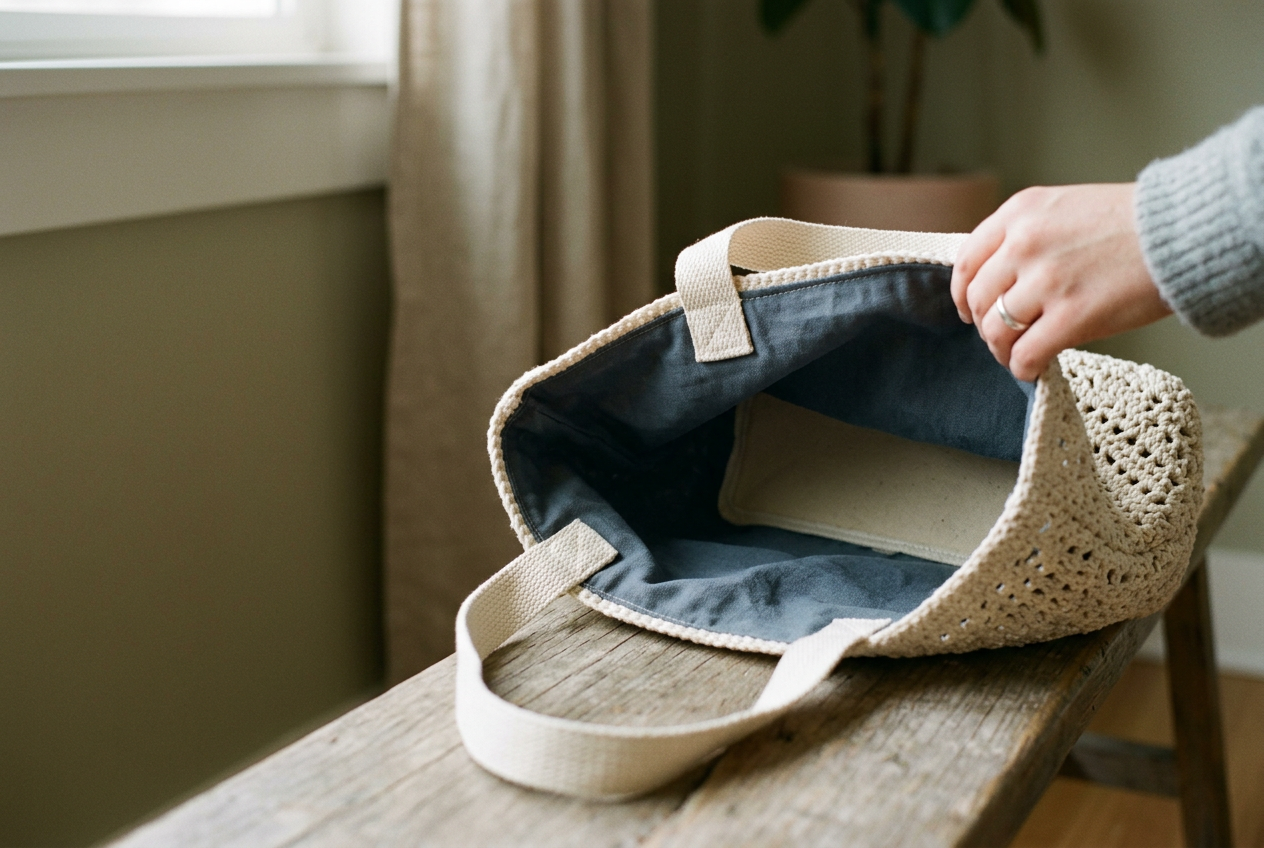
For this comparison, the reference is a lined, 100 percent cotton openwork tote with bound handles and a flat woven base, assessed with the sort of load that exposes weak construction: a 13-inch laptop in a sleeve, a filled reusable bottle, a zip pouch and a light cardigan. It looks much like the unlined versions sold as vacation bags, yet the contents sit at the base rather than pushing through individual loops.
That difference is why the current multiplication of crochet-look bags needs some sorting. “Crochet-look” covers hand-crocheted bags as well as machine-made openwork that imitates interlocking crochet loops, and two nearly identical cream totes can behave differently before either reaches the end of a commute.
This advice is unisex. Fiber behavior and load support do not change across wardrobes, although handle drop and bag scale should still suit the wearer.
The load moves through the whole bag
A tote does not carry weight only at its base. The load travels upward through the body and concentrates where each handle joins it, so a bag can have a sturdy lining and still lengthen into an inconvenient narrow shape when the handles are attached to open loops.
The cotton reference tote passed the basic usefulness test because its handles were bound with dense woven tape, continued below the top edge and connected to a base that did not fold around the laptop. Its lining was anchored at the opening and base rather than hanging as a loose inner sack. Once loaded, the exterior stretched enough to reveal where the bottle sat, but it did not allow the laptop corners to dictate the silhouette.
That is the standard for daily weight. A useful commuter version should preserve a stable base, keep hard objects from poking through the openwork and distribute strain beyond a few decorative loops. The same inspection works in a store: lift the bag by its handles while supporting a book or another flat object inside, then watch the handle joins and bottom rather than the center of the body.
Cotton is forgiving, then slowly gives
Cotton is the easiest crochet-look material to understand and one of the more plausible choices for regular use. It feels soft against clothing, accepts saturated color and can often tolerate gentle spot cleaning, subject to the care label. It also absorbs moisture and stretches under a sustained load.
Recovery, meaning a material’s ability to return to its earlier dimensions after strain, is limited in a loosely worked cotton bag. The openings can lengthen, the bottom can sag and a narrow shoulder strap can become longer over time. Dense yarn and small openings slow that movement, but they do not remove it.
The reference tote’s lining did most of the structural work. Without that layer, the laptop would have pulled directly against the cotton loops, while the bottle would have created a second low point beside it. A removable pouch would hide the contents, but it would not give equivalent support unless it fitted the base closely and attached near the top seam.
Rain is cotton’s other compromise. The yarn absorbs water, becomes heavier and dries slowly when the bag is thick, while deep dyes may transfer if the care instructions warn about colorfastness. A brief shower is not necessarily fatal. Carrying a wet cotton tote by one stretched handle, then leaving it hanging with its contents inside, is how a temporary change becomes a lasting one.
Choose cotton for daily use when the bag is fully lined, the base has a separate reinforcement panel and the handles are woven or doubled. An unlined cotton market bag remains useful for a towel, a soft pouch or groceries carried over a short distance. It is not the sensible place for an unprotected laptop.
Raffia holds a silhouette but dislikes rough handling
Natural raffia comes from palm leaves and has a dry, lightly irregular surface that makes even a simple tote look finished. Compared with soft cotton, tightly worked raffia usually resists lengthwise stretching better and can hold a boxier outline without a heavy internal framework.
Its weakness is less dramatic than sagging. Repeated bending and abrasion can roughen the fibers, particularly at the upper edge, corners and handle joins. A pulled cotton loop may be eased back into the surrounding work; a split raffia strand may remain visibly broken. Openwork raffia also catches on projecting hardware, wicker furniture and rough wall surfaces.
Water response depends partly on treatment and construction, which is why the brand’s material and care notes matter. Natural raffia should not be assumed waterproof. Uneven wetting can leave marks or alter the shape, and aggressive rubbing while damp can damage the surface. A structured raffia bag caught in rain should be emptied, reshaped and dried away from direct heat.
For commuting, raffia works best when the openwork is supported by a textile lining and the handles have a separate load-bearing core, often visible as leather, coated material or dense webbing. The lining should reach the corners. A small interior pocket sewn only onto delicate openwork adds a concentrated pull exactly where the bag needs less of it.
Raffia often occupies a higher price band than cotton or paper-yarn lookalikes, particularly when the work is dense or finished with leather. Price does not guarantee support. If the base folds freely and the handles terminate at the top row of openwork, it is still closer to an occasion bag than a commuter.
Paper yarn is persuasive until it gets wet
Paper yarn is usually made from narrow paper strips that are twisted or braided into a strand. It can imitate raffia convincingly, weighs little and often appears in accessible seasonal bags, including styles with crisp, regular openwork.
The tradeoff is moisture. A coating may help with splashes, but a shopper cannot infer water resistance from a smooth surface, and saturation can weaken, stain or permanently distort paper-based yarn. The care label on the cotton reference tote allowed a degree of cleaning; a paper-yarn label that limits the bag to wiping with a dry cloth describes a much narrower life.
Paper yarn also tends to crease where the bag is repeatedly folded or crushed. Once an edge has softened or a strand has kinked, restoring the original geometry can be difficult. This does not make every paper bag disposable. It makes the material a poor match for a crowded commute, wet umbrella or daily load of hard-edged objects.
A fully lined paper-yarn bag with a rigid insert and independent handles can carry more than its exterior suggests because the internal structure takes the strain. At that point, inspect whether the lining is genuinely attached to the base or merely suspended from the opening. The second version conceals belongings but does little to prevent collapse.
Synthetics handle rain, with a snagging caveat
Synthetic openwork commonly uses polyester, nylon or polypropylene. These fibers absorb less water than cotton and paper yarn, dry faster and can deliver strong, consistent loops at a relatively low bag weight. They are the practical option when summer includes sudden rain or damp public-transit floors.
They are not automatically stable. A loose synthetic knit can stretch considerably, and a slick filament may allow neighboring loops to shift under weight. Once a filament snags, the pulled strand can remain conspicuous because it will not settle into the fuzzy surface the way some cotton yarns do. Heat is another concern, so radiator drying and hot-car storage deserve the same caution given on the care label.
Synthetic bags span broad price bands, from inexpensive market totes to designer pieces where the cost rests on construction, finishing and branding rather than fiber alone. Look for dense handle attachments, a base panel and a lining made from substantial woven fabric. Thin synthetic lining may prevent keys from escaping through the holes, yet still stretch around a laptop corner.
A tightly made synthetic bag can outperform the cotton reference tote in rain response and drying time. Cotton remains more pleasant to repair when a loop shifts, and its softer surface often looks better after minor abrasion. There is no clean winner.
The lining has to carry, not merely cover
Turn the bag inside out if the construction permits. A supportive lining is cut to the bag’s shape, secured near the base and caught into a reinforced top edge; it should not lift several inches away from the outer shell when pulled gently upward.
Check the base next. A removable board can improve shape, though an uncovered insert may dislike spills, while a sewn-in textile reinforcement is less rigid but easier to live with. Laptop carriers should still use a protective sleeve because crochet-look bags rarely offer padding, even when their structure is sound.
Return to the handle join. On the cotton reference tote, woven binding spread the load across more than one row of openwork. That small piece of construction mattered more than the decorative stitch pattern, the neutral color or the generous dimensions.
The buy-or-skip line is therefore fairly plain. Buy cotton or synthetic openwork for daily weight when the lining, base and handles form one support system. Consider dense raffia for lighter commuting if rain exposure is limited. Treat most unlined paper-yarn bags as warm-weather accessories unless a separate internal structure is doing the carrying.
Questions people ask
Do crochet-look bags stretch with use?
Cotton and loose synthetic versions can lengthen under sustained weight, especially when the handles attach directly to open loops. Raffia usually holds its outline better but may split or abrade instead. A fitted lining, reinforced base and handles that extend below the top edge reduce the strain on all four materials.
Can a crochet bag carry a laptop?
It can if the lining is anchored at the base, the bottom stays flat and the handles distribute weight across reinforced fabric rather than a few loops. Use a padded laptop sleeve. An unlined market-style bag may hold the device briefly, but its corners can distort the openwork and accelerate sagging.
Which crochet-look bag material handles rain best?
Polyester, nylon and polypropylene openwork generally absorb less water and dry faster than cotton, natural raffia or paper yarn. Construction and care instructions still matter. A water-resistant exterior does not protect a laptop if rain enters through large openings, so a secure lined compartment remains useful.
How should a wet crochet-look bag be dried?
Empty it, blot surface moisture and reshape it on a flat, ventilated surface away from direct heat. Do not hang a wet cotton or paper-yarn bag by its handles, because the added water weight can set a stretched shape. Follow the brand’s care label before using any cleaner.
One update a day
Today's fashion update, in your inbox
One fashion update each morning — no hype, no filler, just pieces worth wearing.