
Polka Dots Are Back. The Wrong Scale Will Date Faster.
Pin dots tend to endure, oversized spots announce their season, and the middle depends on cut. Here is how to judge polka-dot dresses and accessories before buying.
Women's · October 4, 2026 · 8 min read
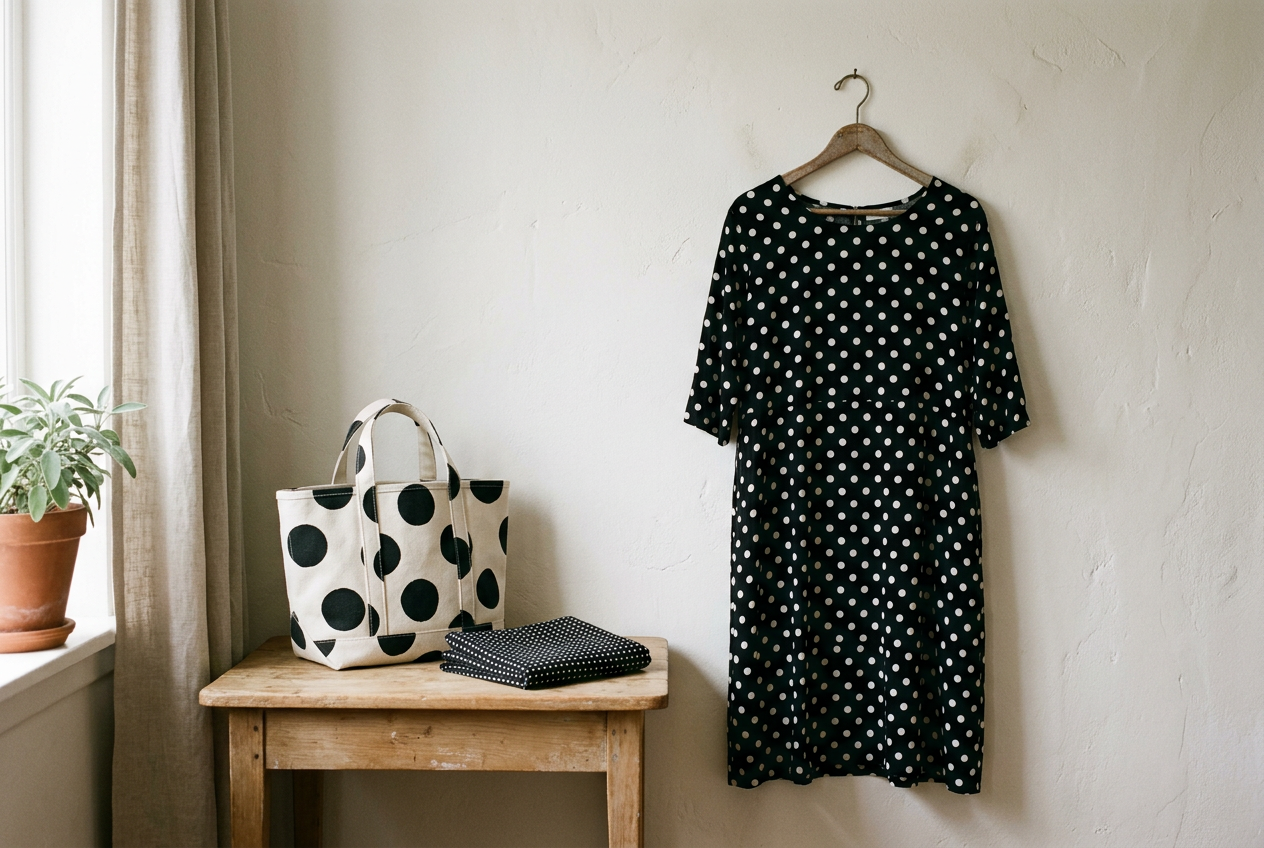
The useful test for this return is the loose, long-sleeved, black-and-white Zara midi dress that became unusually recognizable in 2019. Its medium-scale dots were only part of the effect. The generous smock shape, gathered tiers and stark contrast made the entire dress legible from across a street, which helped it spread and later made it easy to identify in secondhand listings.
That dress is still a good buying lesson. A print can be conventional while the combination of print, cut and moment becomes highly specific. For women deciding among the spotted dresses now appearing at luxury, contemporary and high-street levels, scale is the first filter, but it cannot be the last.
Pin dots ask the least of a wardrobe
Pin dots, meaning spots small enough to read almost as texture at a few steps away, are the lowest-risk version. On a navy crepe dress, a black silk scarf or a fine cotton blouse, they soften a solid color without setting the agenda for the whole outfit. The eye registers movement before it identifies individual circles.
That relative quiet makes pin dots easy to repeat. They sit comfortably beside loafers, narrow belts, denim and plain tailoring, and they do not require the rest of an outfit to become deliberately retro or graphic. A small repeat, meaning the measured distance before the pattern starts again, also tends to hide minor interruptions at seams more gracefully than a large motif does.
Fabric still matters. On lightweight viscose, pin dots can blur when the cloth gathers at a waist or twists along a bias cut, where fabric is cut diagonally across the grain for extra drape. That is usually forgiving. On thin polyester with a glossy surface, the same print can look busier under strong light, while static may pull the skirt against tights and distort the fall.
The compromise is impact. A pin-dot dress may survive several styling cycles, yet it will not deliver the emphatic spotted look shown in a campaign image. If the aim is a print that earns attention by itself, paying luxury prices for tiny dots may not feel worthwhile unless the fabric, lining and seam finish justify the difference.
Accessories make pin dots even less demanding. A dotted silk scarf can be folded until only fragments of the pattern show, while a compact bag in a tiny repeat behaves much like a neutral from conversational distance. Check alignment around an exterior pocket or flap. Poor matching is more noticeable on a structured accessory because the surface stays flat.
Medium dots hand more power to the cut
Medium dots, roughly coin-sized on a dress, occupy the unstable center. They are familiar enough to recur across decades, but large enough for spacing and contrast to define the garment. This is where the 2019 Zara dress becomes useful again: its spots were not inherently short-lived, yet the dots and voluminous tiered shape became one visual unit.
Put a similar repeat on a column dress with a square neckline and it will belong to a different styling cycle. Place it on a tea dress with a fitted waist, flutter sleeve and covered buttons, and the vintage reference becomes stronger. The print has not changed much. The silhouette has done the dating.
For a medium repeat, inspect the side seams before the front view wins you over. Dots sliced unevenly at a center-front placket can make an otherwise polished dress look cheaper, and a line of circles that drifts downward at one side seam may exaggerate twisting after laundering. Perfect pattern matching uses more cloth and raises production costs, so it is uncommon at lower price bands, but the most visible joins should still look intentional.
A dark ground with pale dots is generally calmer than a pale ground with dark dots because the larger field recedes. Lower contrast extends the useful life further: chocolate with cream, navy with faded blue, or black with charcoal can move between patterned and nearly solid depending on the light. Crisp black on white carries more graphic force and leaves less room for an indifferent shoe or jacket.
This scale works best for a buyer who likes to alter the framing. A plain cardigan reduces the visible area. A leather belt breaks the repeat at the waist. Worn open under a jacket, a dotted shirtdress becomes a narrow printed panel rather than a complete field.
Those are practical changes, not rescue operations, and they can keep a medium repeat from feeling locked to the styling shown when it first reached stores.
Oversized spots spend their novelty quickly
Oversized spots are the clear trend purchase. On a full-length dress, circles approaching the width of a hand create strong negative space, the unprinted area around each motif, and the garment can look different from every angle. A spot centered on the torso may dominate the fit; another cut in half at the hip can pull the eye sideways.
This is also the scale most vulnerable to production shortcuts. A large repeat needs thoughtful placement, particularly across bust darts, gathered seams and zippers. Try the dress from the side as well as the front. If one circle folds into a seam and appears to narrow or widen with movement, it may create a fit issue that the solid-color version of the same dress would not have.
Oversized spots can make more sense on an accessory. A large circle cropped by the edge of a clutch or scarf may read as an abstract curve, which loosens its link to one polka-dot cycle. A soft tote is less predictable because the motif collapses as the bag fills, while a rigid box bag preserves the design but announces it more loudly.
There is no construction trick that turns this scale into a neutral. Buyers who enjoy a short, distinct styling phase may consider that the point. Anyone looking for a dress to wear repeatedly at work, dinners and summer events should demand more from the underlying garment: an excellent neckline, enough seam allowance for alteration, a lining that prevents cling, and a cut worth wearing after the print loses its freshness.
Secondhand listings expose what has dated
Resale is useful here because older polka dots rarely disappear; they separate into recognizable periods. Search results on broad platforms commonly mix spotted wrap dresses, fit-and-flare styles, tiered midis, office blouses and scarves, allowing the silhouette around the print to reveal its age more clearly than a current retailer’s coordinated styling does.
Search by garment and color before using a trend term. “Black white spot midi dress” will usually produce a wider and less curated field than language such as “viral polka-dot dress.” Then compare listings with sold results where a platform provides them. An asking price shows hope, while a sold listing provides firmer evidence that a garment found a buyer, though condition and size still affect the comparison.
The Zara dress can be identified quickly in that environment because its dot scale, loose sleeves and gathered tiers travel together. Recognition may help a seller describe it, but recognition is not the same as durability. A less famous medium-dot dress with cleaner construction may integrate into a current wardrobe more easily precisely because it carries less shared memory.
Photos of the care label deserve more attention than the seller’s decade label. Viscose may drape well but can shrink or distort if washed against its instructions. Polyester tends to hold the print and resist creasing, though it may trap heat and static. Silk gives dots depth and movement, but cleaning costs can turn an inexpensive secondhand scarf or dress into a less casual purchase.
Look closely at pale grounds. Underarm discoloration, makeup at the neckline and dye transfer are harder to disguise on white or cream, while black grounds can show fading at seams. On oversized motifs, request a full back view if one is missing; a front that looks balanced does not guarantee that the repeat was placed well across the zipper.
A scale test before checkout
Reduce the product image until the dress is thumbnail-sized. If the dots still dominate, the print will lead most outfits and is likely to feel tied to this particular return. If the garment reads as a silhouette first and a pattern second, it has more room to move through different shoes, jackets and occasions.
Next, ignore the dots and assess the cut as though it were solid. The 2019 Zara dress passes or fails here according to a buyer’s appetite for a loose, tiered midi, not according to whether medium spots are currently rising. A waist seam that sits badly, a sleeve that crowds a jacket or an unlined skirt that clings will remain irritating after the trend attention moves elsewhere.
Finally, price the maintenance. A hand-wash label, specialist cleaning or repeated steaming may be acceptable for silk with careful seam work. It is harder to defend on a synthetic dress with poorly matched panels. Print scale cannot compensate for a garment that costs too much time to put back into rotation.
Questions people ask
Which polka-dot size is least likely to look dated?
Pin dots are generally the safest because they behave like surface texture and do not control the whole outfit. Medium dots can also last when the dress has a restrained silhouette and moderate contrast. Oversized spots stay recognizable, but their strong placement makes them easier to associate with a particular trend cycle.
Are black-and-white polka dots more timeless than colored ones?
Black and white recur often, but high contrast can make scale and silhouette more conspicuous. Navy with cream, brown with ecru or tonal combinations may integrate more quietly. Construction matters more than conventional coloring if the seams interrupt circles or the fabric loses its shape after cleaning.
What should
I check when buying a polka-dot dress secondhand?
Ask for the care label, a full back image and close views of the side seams, zipper and underarms. Check whether large dots create awkward shapes across the bust or hips. Compare sold listings where available, but give condition, fabric and a cut you already wear more weight than recognition.
Do oversized polka dots work better on accessories?
Often, because the edge of a scarf or structured bag crops a large circle into a less literal shape. The print also occupies less of the body. Soft bags can distort oversized spots as they fill, so examine how the pattern looks when the accessory is carried rather than photographed flat.
One update a day
Today's fashion update, in your inbox
One fashion update each morning — no hype, no filler, just pieces worth wearing.